
android kotlin - String replace range example

MainActivity.kt

package com.cfsuman.kotlintutorials

import android.os.Bundle
import android.text.method.ScrollingMovementMethod
import android.widget.TextView
import androidx.appcompat.app.AppCompatActivity


class MainActivity : AppCompatActivity() {
    override fun onCreate(savedInstanceState: Bundle?) {
        super.onCreate(savedInstanceState)
        setContentView(R.layout.activity_main)

        // get the widgets reference from XML layout
        val textView = findViewById<TextView>(R.id.textView)

        // make textview content scrollable
        textView.movementMethod = ScrollingMovementMethod()


        val string = "Lorem Ipsum is simply dummy text of the" +
                " printing and typesetting industry. Lorem Ipsum" +
                " has been the industry's standard dummy text" +
                " ever since the 1500s."

        textView.text = string

        // The end index of the range is included
        // in the part to be replaced.
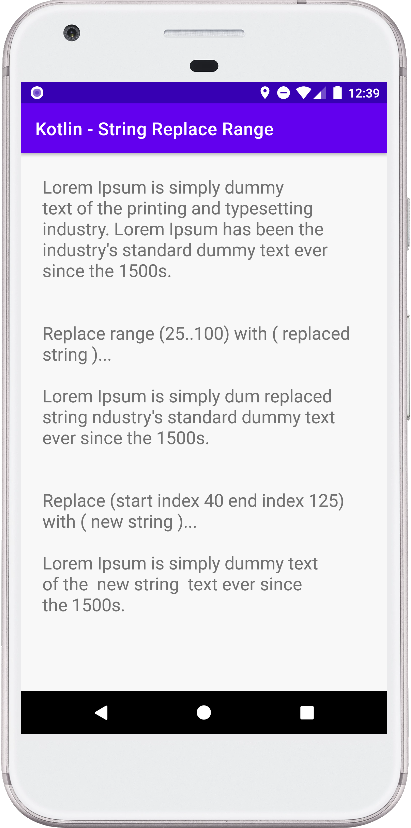
        val result = string.replaceRange(
            25..100, // range
            " replaced string " // replacement
        )

        textView.append("\n\n\n")
        textView.append("Replace range (25..100) with " +
                "( replaced string )...\n\n")
        textView.append(result)


        /*
            documentation source kotlinlang.org
                Replaces the part of the string at the given
                range with the replacement char sequence.

                startIndex - the index of the first character to be replaced.
                endIndex - the index of the first character after
                           the replacement to keep in the string.
        */
        val result2 = string.replaceRange(
            40, // start index
            125, // end index
            " new string " // replacement
        )

        textView.append("\n\n\n")
        textView.append("Replace (start index 40 end index" +
                " 125) with ( new string )...\n\n")
        textView.append(result2)
    }
}
activity_main.xml

<?xml version="1.0" encoding="utf-8"?>
<androidx.constraintlayout.widget.ConstraintLayout
    xmlns:android="http://schemas.android.com/apk/res/android"
    xmlns:app="http://schemas.android.com/apk/res-auto"
    xmlns:tools="http://schemas.android.com/tools"
    android:layout_width="match_parent"
    android:layout_height="match_parent"
    android:background="#F8F8F8"
    android:padding="24dp">

    <TextView
        android:id="@+id/textView"
        android:layout_width="0dp"
        android:layout_height="0dp"
        android:fontFamily="sans-serif"
        android:textSize="20sp"
        app:layout_constraintBottom_toBottomOf="parent"
        app:layout_constraintEnd_toEndOf="parent"
        app:layout_constraintStart_toStartOf="parent"
        app:layout_constraintTop_toTopOf="parent" />

</androidx.constraintlayout.widget.ConstraintLayout>
Popular posts from this blog

Restricting Jetpack Compose TextField to Numeric Input Only

Jetpack Compose has revolutionized Android development with its declarative approach, enabling developers to build modern, responsive UIs more efficiently. Among the many components provided by Compose, TextField is a critical building block for user input. However, ensuring that a TextField accepts only numeric input can pose challenges, especially when considering edge cases like empty fields, invalid characters, or localization nuances. In this blog post, we'll explore how to restrict a Jetpack Compose TextField to numeric input only, discussing both basic and advanced implementations. Why Restricting Input Matters Restricting user input to numeric values is a common requirement in apps dealing with forms, payment entries, age verifications, or any data where only numbers are valid. Properly validating input at the UI level enhances user experience, reduces backend validation overhead, and minimizes errors during data processing. Compose provides the flexibility to implement ...

jetpack compose - TextField remove underline

Compose TextField Remove Underline The TextField is the text input widget of android jetpack compose library. TextField is an equivalent widget of the android view system’s EditText widget. TextField is used to enter and modify text. The following jetpack compose tutorial will demonstrate to us how we can remove (actually hide) the underline from a TextField widget in an android application. We have to apply a simple trick to remove (hide) the underline from the TextField. The TextField constructor’s ‘colors’ argument allows us to set or change colors for TextField’s various components such as text color, cursor color, label color, error color, background color, focused and unfocused indicator color, etc. Jetpack developers can pass a TextFieldDefaults.textFieldColors() function with arguments value for the TextField ‘colors’ argument. There are many arguments for this ‘TextFieldDefaults.textFieldColors()’function such as textColor, disabledTextColor, backgroundColor, cursorC...

jetpack compose - Image clickable

Compose Image Clickable The Image widget allows android developers to display an image object to the app user interface using the jetpack compose library. Android app developers can show image objects to the Image widget from various sources such as painter resources, vector resources, bitmap, etc. Image is a very essential component of the jetpack compose library. Android app developers can change many properties of an Image widget by its modifiers such as size, shape, etc. We also can specify the Image object scaling algorithm, content description, etc. But how can we set a click event to an Image widget in a jetpack compose application? There is no built-in property/parameter/argument to set up an onClick event directly to the Image widget. This android application development tutorial will demonstrate to us how we can add a click event to the Image widget and make it clickable. Click event of a widget allow app users to execute a task such as showing a toast message by cli...