MainActivity.kt
package com.cfsuman.kotlinexamples

import android.Manifest
import android.content.Context
import android.graphics.Bitmap
import android.support.v7.app.AppCompatActivity
import android.os.Bundle
import android.widget.Toast
import kotlinx.android.synthetic.main.activity_main.*
import android.os.Build
import android.view.View
import android.app.DownloadManager
import android.net.Uri
import android.os.Environment
import android.webkit.*


class MainActivity : AppCompatActivity() {
    private val url = "https://en.savefrom.net/"
    private val PermissionsRequestCode = 123
    private lateinit var managePermissions: ManagePermissions

    override fun onCreate(savedInstanceState: Bundle?) {
        super.onCreate(savedInstanceState)
        setContentView(R.layout.activity_main)

        // Initialize a list of required permissions to request runtime
        val list = listOf<String>(
                Manifest.permission.WRITE_EXTERNAL_STORAGE
        )

        // Initialize a new instance of ManagePermissions class
        managePermissions = ManagePermissions(this,list,PermissionsRequestCode)

        if (Build.VERSION.SDK_INT >= Build.VERSION_CODES.M) managePermissions.checkPermissions()

        // Get the web view settings instance
        val settings = web_view.settings

        // Enable java script in web view
        settings.javaScriptEnabled = true

        // Enable and setup web view cache
        settings.setAppCacheEnabled(true)
        settings.cacheMode = WebSettings.LOAD_DEFAULT
        settings.setAppCachePath(cacheDir.path)


        // Enable zooming in web view
        settings.setSupportZoom(true)
        settings.builtInZoomControls = true
        settings.displayZoomControls = true


        // Zoom web view text
        settings.textZoom = 125


        // Enable disable images in web view
        settings.blockNetworkImage = false
        // Whether the WebView should load image resources
        settings.loadsImagesAutomatically = true


        // More web view settings
        if (Build.VERSION.SDK_INT >= Build.VERSION_CODES.O) {
            settings.safeBrowsingEnabled = true  // api 26
        }
        //settings.pluginState = WebSettings.PluginState.ON
        settings.useWideViewPort = true
        settings.loadWithOverviewMode = true
        settings.javaScriptCanOpenWindowsAutomatically = true
        settings.mediaPlaybackRequiresUserGesture = false


        // More optional settings, you can enable it by yourself
        settings.domStorageEnabled = true
        settings.setSupportMultipleWindows(true)
        settings.loadWithOverviewMode = true
        settings.allowContentAccess = true
        settings.setGeolocationEnabled(true)
        settings.allowUniversalAccessFromFileURLs = true
        settings.allowFileAccess = true

        // WebView settings
        web_view.fitsSystemWindows = true


        /*
            if SDK version is greater of 19 then activate hardware acceleration
            otherwise activate software acceleration
        */
        web_view.setLayerType(View.LAYER_TYPE_HARDWARE, null)


        // Set web view client
        web_view.webViewClient = object: WebViewClient(){
            override fun onPageStarted(view: WebView, url: String, favicon: Bitmap?) {
                // Page loading started
                // Do something
                toast("Page loading.")
            }

            override fun onPageFinished(view: WebView, url: String) {
                // Page loading finished
                // Display the loaded page title in a toast message
                toast("Page loaded: ${view.title}")
            }
        }


        // Set web view chrome client
        web_view.webChromeClient = object: WebChromeClient(){
            override fun onProgressChanged(view: WebView, newProgress: Int) {
                progress_bar.progress = newProgress
            }
        }


        // Set web view download listener

        web_view.setDownloadListener(DownloadListener {
            url,
            userAgent,
            contentDescription,
            mimetype,
            contentLength ->

            // Initialize download request
            val request = DownloadManager.Request(Uri.parse(url))

            // Get the cookie
            val cookies = CookieManager.getInstance().getCookie(url)

            // Add the download request header
            request.addRequestHeader("Cookie",cookies)
            request.addRequestHeader("User-Agent",userAgent)

            // Set download request description
            request.setDescription("Downloading requested file....")

            // Set download request mime tytpe
            request.setMimeType(mimetype)

            // Allow scanning
            request.allowScanningByMediaScanner()

            // Download request notification setting
            request.setNotificationVisibility(
                    DownloadManager.Request.VISIBILITY_VISIBLE_NOTIFY_COMPLETED)

            // Guess the file name
            val fileName = URLUtil.guessFileName(url, contentDescription, mimetype)

            // Set a destination storage for downloaded file
            request.setDestinationInExternalPublicDir(Environment.DIRECTORY_DOWNLOADS, fileName)

            // Set request title
            request.setTitle(URLUtil.guessFileName(url, contentDescription, mimetype));


            // DownloadManager request more settings
            request.setAllowedOverMetered(true)
            request.setAllowedOverRoaming(false)
            if (Build.VERSION.SDK_INT >= Build.VERSION_CODES.N) {
                request.setRequiresCharging(false)
                request.setRequiresDeviceIdle(false)
            }
            request.setVisibleInDownloadsUi(true)


            // Get the system download service
            val dManager = getSystemService(Context.DOWNLOAD_SERVICE) as DownloadManager

            // Finally, request the download to system download service
            dManager.enqueue(request)
        })


        // Load button click listener
        button_load.setOnClickListener{
            // Load url in a web view
            web_view.loadUrl(url)
        }

    }


    // Receive the permissions request result
    override fun onRequestPermissionsResult(requestCode: Int, permissions: Array<String>,
                                            grantResults: IntArray) {
        when (requestCode) {
            PermissionsRequestCode ->{
                val isPermissionsGranted = managePermissions
                        .processPermissionsResult(requestCode,permissions,grantResults)

                if(isPermissionsGranted){
                    // Do the task now
                    toast("Permission(s) granted.")
                }else{
                    toast("Permission(s) denied.")
                }
                return
            }
        }
    }


    // Handle back button press in web view
    override fun onBackPressed() {
        if (web_view.canGoBack()) {
            // If web view have back history, then go to the web view back history
            web_view.goBack()
            toast("Going to back history")
        } else {
            super.onBackPressed()
        }
    }
}


// Extension function to show toast message
fun Context.toast(message: String) {
    Toast.makeText(this, message, Toast.LENGTH_SHORT).show()
}
activity_main.xml
<?xml version="1.0" encoding="utf-8"?>
<LinearLayout
    xmlns:android="http://schemas.android.com/apk/res/android"
    xmlns:tools="http://schemas.android.com/tools"
    xmlns:app="http://schemas.android.com/apk/res-auto"
    android:layout_width="match_parent"
    android:layout_height="match_parent"
    android:background="#edfaed"
    android:padding="0dp"
    android:orientation="vertical"
    >
    <ProgressBar
        android:id="@+id/progress_bar"
        android:layout_width="match_parent"
        android:layout_height="wrap_content"
        style="@style/Widget.AppCompat.ProgressBar.Horizontal"
        />
    <Button
        android:id="@+id/button_load"
        android:layout_width="wrap_content"
        android:layout_height="wrap_content"
        android:text="Load URL"
        android:textAllCaps="false"
        />
    <WebView
        android:id="@+id/web_view"
        android:layout_width="match_parent"
        android:layout_height="0dp"
        android:layout_weight="1"
        />
</LinearLayout>
ManagePermissions.kt
package com.cfsuman.kotlinexamples

import android.app.Activity
import android.content.pm.PackageManager
import android.support.v4.app.ActivityCompat
import android.support.v4.content.ContextCompat
import android.support.v7.app.AlertDialog


class ManagePermissions(private val activity: Activity,
                        private val list: List<String>,val code:Int
) {

    // Check permissions at runtime
    fun checkPermissions() {
        if (isPermissionsGranted() != PackageManager.PERMISSION_GRANTED) {
            showAlert()
        } else {
            activity.toast("Permission(s) already granted.")
        }
    }


    // Check permissions status
    private fun isPermissionsGranted(): Int {
        // PERMISSION_GRANTED : Constant Value: 0
        // PERMISSION_DENIED : Constant Value: -1
        var counter = 0;
        for (permission in list) {
            counter += ContextCompat.checkSelfPermission(activity, permission)
        }
        return counter
    }


    // Find the first denied permission
    private fun deniedPermission(): String {
        for (permission in list) {
            if (ContextCompat.checkSelfPermission(activity, permission)
                    == PackageManager.PERMISSION_DENIED) return permission
        }
        return ""
    }


    // Show alert dialog to request permissions
    private fun showAlert() {
        val builder = AlertDialog.Builder(activity)
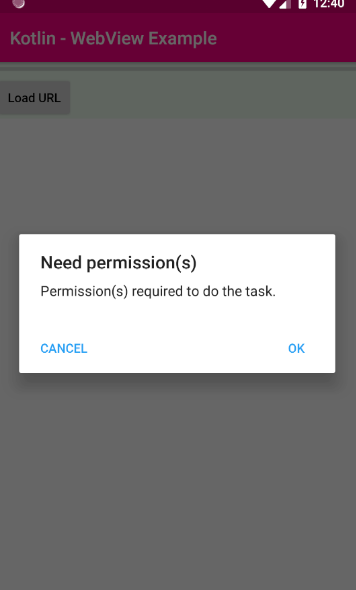
        builder.setTitle("Need permission(s)")
        builder.setMessage("Permission(s) required to do the task.")
        builder.setPositiveButton("OK", { _, _ -> requestPermissions() })
        builder.setNeutralButton("Cancel", null)
        val dialog = builder.create()
        dialog.show()
    }


    // Request the permissions at run time
    private fun requestPermissions() {
        val permission = deniedPermission()
        if (ActivityCompat.shouldShowRequestPermissionRationale(activity, permission)) {
            // Show an explanation asynchronously
            activity.toast("Should show an explanation.")
        } else {
            ActivityCompat.requestPermissions(activity, list.toTypedArray(), code)
        }
    }


    // Process permissions result
    fun processPermissionsResult(requestCode: Int, permissions: Array<String>,
                                 grantResults: IntArray): Boolean {
        var result = 0
        if (grantResults.isNotEmpty()) {
            for (item in grantResults) {
                result += item
            }
        }
        if (result == PackageManager.PERMISSION_GRANTED) return true
        return false
    }
}
AndroidManifest.xml [Permissions]
    <uses-permission android:name="android.permission.INTERNET" />
    <uses-permission android:name="android.permission.WRITE_EXTERNAL_STORAGE"/>